
How do you convince large companies to trust and invest in fragile education ecosystems?
Evidence from the GIFT Project: Designing and operationalizing a large-scale private sector engagement model that connected large employers, training institutions, and youth employability systems in the Democratic Republic of Congo.
EXECUTIVE SUMMARY
Over 13 months, Olive People designed and operationalized a private sector engagement model that transformed large employers from observers into both active partners of training institutions and investors in the employability of future university graduates and young entrepreneurs in the agricultural and agrifood sectors.
The biggest challenge was structural: the profound lack of trust between the private sector and training institutions. As a result, there had been historically no sustained dialogue between stakeholders, let alone any cross-sector collaboration.
This in turn exacerbated the skills mismatch and the low employment in the region.
Olive People’s private sector engagement model restored trust between large employers and training institutions, created pathways for youth employability and entrepreneurship, and established the foundations for sustainable industry-education collaboration.
A major tangible outcome is the evolution of the employer as shown below:

THE CHALLENGES
Improving education and employability in the agricultural and agrifood sectors required addressing a series of structural challenges affecting employers, training institutions, and future graduates and young entrepreneurs.
Weak Employer Engagement in Skills Development
The first challenge was the limited engagement of large employers in development and workforce initiatives. Large companies in the agricultural and agrifood sectors were undergoing a strong transformation driven by technological innovation, intensification, sustainability standards, and diversification.
In this context, they perceived that development interventions were unaware of business realities and insufficiently aligned with industry interests.
As a result, collaboration between companies and training institutions remained sporadic and transactional, rather than strategic and sustained.
Skills Mismatch Among Future Graduates and Entrepreneurs
The second challenge was the persistent mismatch between the skills possessed by university graduates and young entrepreneurs, and the competencies required by employers. Many young people typically enrolled in agricultural and agrifood studies based on poor career guidance and wrong perceptions about opportunities in the labour market.
During their training, they received little exposure to modern industry practices, recruiter expectations, and practical workplace experience. Post graduation, they lacked both the technical competencies, workplace professionalism, and the soft skills demanded by employers. They also displayed unrealistic career expectations.
Limited Linkages Between Education and Industry
The third challenge was the profound disconnect between training institutions and the private sector.
Training professionals and faculty members lacked knowledge of evolving industry trends and emerging occupations and were unaware of in-demand competencies. Relationships between training institutions and employers were weak, resulting in limited opportunities for dialogue, curricula alignment, and work-based learning.
As a result, training programs typically did not equip students with the technical competencies and workplace preparedness required by the labor market.
Lack of Trust Between Stakeholders
The fourth challenge – and most critical challenge, was the lack of trust between the private sector and training institutions.
Many corporate companies questioned whether training institutions possessed the organizational capacity and a robust commitment to engage in the dialogue process.
They also reported instances of past development initiatives that had failed to show consistency and deliver results.
Implications for the Project
Put together, these challenges revealed that the primary impediment to start and progress in the project was the lack of trust, alignment, and mechanisms for collaboration.
This required the design of a compelling value proposition for employers, the design of structured processes for dialogue and collaboration, and a sound strategy to restore trust between the private sector and training institutions.
Tackling these systemic obstacles was the surest path to create opportunities for reducing the skills mismatch and the employability deficit affecting youth employment and entrepreneurship in the agriculture and agrifood sectors.
THE ASSIGNMENT
Olive People was mandated by Enabel, the international development agency of the Kingdom of Belgium, under the GIFT Project, to mobilize the private sector and design mechanisms for large corporate companies to collaborate with the training institutions and to support the practical employability of future university graduates as well as the integration of young entrepreneurs in the agriculture and agrifood value chains.
STRATEGIC INSIGHT
We found that the lack of trust between large corporate companies and training institutions was the primary barrier to private sector engagement.
The lack of trust was persistent, transcending provinces, industries, companies, and functions. It showed up in various forms from plain unresponsiveness to limited involvement by the private sector.
Yet training institutions grappled with realizing the full depth and scope of the lack of trust.
This added a second challenge: building awareness among training institutions about private sector engagement – what it meant exactly, what it concretely implied for them, and what was at stakes.
THE METHODOLOGY
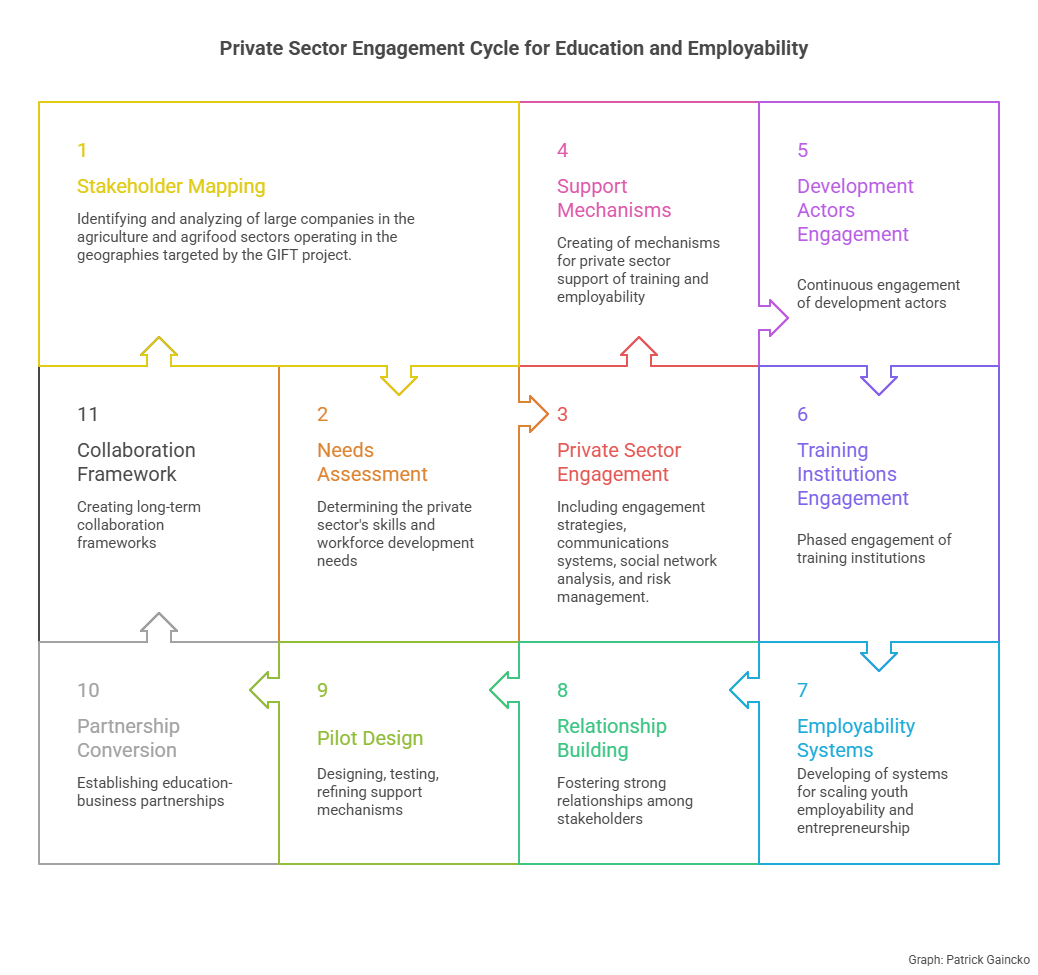
SOME KEY ACTIVITIES
Integration of the GIFT Project into Impact Job Days, a pan-African platform dedicated to green skills, sustainable careers, and cross-sector partnerships.
Collaboration workshops and dialogue sessions, convening employers, training institutions, development actors, alumni students, and student groups.
Design of a framework for large-scale deployment of internships and integration of upcoming entrepreneurs in value chains.
Private sector engagement awareness sessions for training institutions and development actors.
THE OUTCOMES
1) Large employers moved from prospective to confirmed partners
Through a structured process of trust building, systemized relationship building, and the creation of systems and mechanisms, employers who initially displayed limited interest evolved into highly involved partners for advancing work-based learning and long-term collaboration with training institutions.
This evolution represented a significant cultural change in a context where the dialogue between employers and training institutions had historically been sporadic.
2) A skills ecosystem model emerged for employability and employment
The model contributed to the emergence of a broader ecosystem connecting training, talent, and opportunities. The model created systems for operational and workplace exposure, entrepreneurship support and value chain integration, and future employment pathways.

4) Tangible Outcomes
The model generated measurable outputs and established foundations for future scaling.

5) Trust as a strategic asset
The outcome reached first and that most contributed to the overall health of the project was: restored trust between stakeholders.
Through continuous engagement, shared problem solving, and structured dialogue, employers increasingly viewed training institutions and development actors as credible partners. This relational capital created opportunities that extended beyond the duration of the project itself.
BROADER LESSONS FOR EDUCATION-INDUSTRY PARTNERSHIPS
While conducting a complex process of mobilizing large corporate companies for support of training institutions, it was natural for the Project to meet challenges.
Each challenge presented opportunities to learn and initiate adjustments to move forward. What follows is a summary of the primary lessons learned for continuing the dialogue and collaboration between educational institutions and the private sector in the future.
Lesson 1: Trust generates opportunities for collaboration, but building trust requires ample time and continuous efforts.
Building trust from scratch is already a demanding matter, but in this case, it was an even more painstaking matter because trust between the private sector and training institutions had eroded before the project came in.
Therefore, it took more time and space and dedicated resources to restore trust and build relationships in a sequential and systemized way.
Moreover, approaches adopted at the beginning of the Project evolved over time as decision makers and organizational priorities changed.
Lesson 2: Engaging employers must begin in the design phase of the project.
A reason why the skills mismatch was significant was the fact that the youth typically acquired practical experience and workplace preparedness only in their final university year.
As a result, it became necessary to involve government entities such as the Ministry of Education in their role of policymaking and shaping education programs.
Only them had the power to revisit education programs in a way that enabled the youth to learn the skills needed by the labour market and to acquire practical experience early in their education journey.
Lesson 3: Even modest initiatives are opportunities to seize to achieve big goals
We learned that in a context where private sector stakeholders were unfamiliar with the benefits of supporting training institutions and youth employability, effective approaches at making significant wins consisted of converting opportunities progressively and working with pilot projects and downsized ambitions.
Originally, the Project aimed at securing a superior number of education-industry partnerships. However, that approach quickly encountered roadblocks. There were few success examples showcasing the feasibility of such partnerships and many employers remained cautious about commitments.
As a result, we adopted an agile project management methodology consisting of continuous testing and incremental progress towards the goals of building awareness, fostering dialogue, and building momentum for collaboration.
WHERE THE MODEL CAN BE REUSED
As several industries face a growing shortage of skilled talent and several education ecosystems struggle to align what they produce with the skills and competencies the labour market require, a natural question emerges: can the private sector engagement model designed and operationalized through the GIFT Project applies beyond the agriculture and agrifood sectors.
Our experience suggests it can.
Various challenges transcend industries, notably the lack of trust between industry and education institutions, limited dialogue between stakeholders, and acute skills mismatch.
For this reason, the model is not only highly transferable to other sectors, but it has already been part of industry conversations in several contexts where employers, higher education institutions, vocational schools, and development actors share interests in strengthening employability, reducing skills mismatches, and building sustainable partnerships between education systems and employers.
-
As Africa's energy sector expands and diversifies, employers face growing demand for technicians, engineers, project managers, and sustainability professionals. The model can support workforce development partnerships that align training programmes with rapidly evolving industry requirements.
-
As Africa’s forest management sector is adopting sustainability standards and certification requirements and technological innovation more rapidly than any other sector, this model can be part of joint efforts by training providers and employers to develop the sustainability skills needed in responsible, modern forest management.
-
Large infrastructure projects frequently struggle to source qualified local talent at the scale required for implementation. The model can facilitate partnerships that prepare young people for careers in construction, engineering support, project administration, operations, maintenance, and related occupations.
-
Manufacturing firms require a continuous supply of production, maintenance, quality assurance, logistics, and supervisory talent. By strengthening dialogue between employers and training institutions, the model can contribute to more responsive training systems and stronger school-to-work transitions.
-
Across mining ecosystems, large companies increasingly require local content, technical proficiency, and health and safety competencies that are often rare in local labour markets. The model can help deepen collaboration between stakeholders to accelerate workforce readiness and local content outcomes.