OLIVE PEOPLE BRIEFING #2
TABLE OF CONTENT:
Local Content: Why Hiring Alone is Never Enough
Signals & Observations
Ecosystem Spotlight: A New EU financing Model
Strategic Update: New Partnership Université Senghor-Olive People
Local Content: Why Hiring Alone is Never Enough
By Patrick Gaincko, PMP, PHRi
Reading time: 4min
Executive Takeaway: Local content has become a key indicator of organizational performance in the mining industry. But how can the industry maintain its progress towards local content?
Hiring alone is merely competing for scarce talent. It’s also costly.
The solution: treating local content as a capacity-building strategy. Leaders that invest in skills ecosystems create the talent pipeline they need to strengthen their resilience and sustain their growth.
All the Morocco National Football Team players at the FIFA World Cup 2026 were born outside of Morocco. Would you consider them local talent?
Last month at the DRC Mining Week, a major mining industry platform, CEO conversations provided an update on the mining industry’s progress towards local content. One company said their workforce is 97% Congolese, another said they are building a team of 100% local, and a third one was more precise, saying that their C-level and senior executives are 100% local.
These conversations show that organizations have different ways of measuring the degree to which their workforce is local.
Let’s see the different definitions of “local” that emerged:
The number of nationals from top to bottom in the organization
The number of nationals in leadership positions
All the above, including dual-citizens possessing work experience in the country where the organization operates
All the above, including employees perceived as nationals. That’s professionals of foreign origin with extensive life- and work experience in the country where the organization operates.
Regardless of the definition, one conclusion is clear: local content is now an established strategic performance indicator.
But once organizations pursue the local content trajectory, how can they sustain their progress or maintain their leadership in local content?
This question matters because stakeholder expectations for greater local participation keep growing.
Among the stakeholders most favorable to local content are investors, as they want business continuity and sustainability in reputation, operations, and other aspects.

THE SOLUTION COMES FROM A SHIFT
Many organizations instinctively respond to stakeholders expectations by hiring local professionals.
The problem: Hiring does not create capacities. It merely reallocates scarce talent from one place to another.
Also, local talent strategies that rely solely on hiring are resource-consuming and costly. That’s because the local talent pool is very limited, whether it involves technical talent such as engineers, geologists, and hydrologists; or managerial talent.
An option that ensures a sustainable and reliable supply of qualified local talent is capacity development.
Why: Ultimately, what companies really mean by local content is professionals who understand local markets, who can navigate complex environments and solve local problems, who keep on functioning locally when health-, or political crises strike.
Where to find these professionals: In the talent growing up locally, feeling a sense of belonging, and seeing their future locally. They are personally invested in local economic development.
Therefore, the organizations that will be able to build resilience and sustain growth are those who invest in developing local skills ecosystems.
Skills ecosystems don’t just produce talent. They continuously replenish and strengthen local talent pools on which future competitiveness depends.
In an interview touching on local content, the President of the Moroccan Football Federation said, “Look at our bench: the number of Morocco-born players is growing.”
While still relying on diaspora players, Morocco is investing in domestic football academies that continuously expand the next generation home-grown players. According to most sports analysts, this has significantly helped Morocco remain in the global football elite (consecutively qualified for the World Cup, ranked 6th in the FIFA World Rankings).
Local content follows the same logic. Recruiting alone is consuming – at high cost - scarce local talent for today's vacancies. Developing local skills ecosystems is continuously producing a critical mass of capacities for tomorrow and beyond.
Signals & Observations
By Patrick Gaincko, PMP, PHRi
Reading time: 5min
The following signals are not forecasts. They are recurring patterns emerging from our work and ongoing monitoring of the sustainability, the ESG, and workforce landscapes.
Signal #1: Banks are changing their role in SME development
Banks continue to adopt a conservative approach in the matter of financing young businesses. Yet, they remain interested in supporting SMEs.
How: Some banks choose to be a part of niche, highly specific SME support programs. In those programs and initiatives, they don’t play a leading role.
They take a back seat with a long view, spotting the most promising SMEs and monitoring dynamics in SME ecosystems. They then intervene at a designated point in the SME development phase to engage in the dialogue with growing founders or provide technical assistance and strategic guidance.
Why this matters: When SMEs understand the real role of banks in the support ecosystem, they become capable of identifying the stakeholders they should prioritize in their pursuit of partnerships.

Signal #2: Career aspirations are shaped long before recruitment
In a recent visit to three vocational schools, I observed the following:
At the vocational school located close to a large manufacturing company and frequently visited by industry insiders, students could precisely name the job they wanted to do in the future.
At the vocational school located not in direct proximity to the manufacturer and periodically visited by industry insiders, students could name the industries in which they saw themselves working in the future.
At the vocational school with no proximity to the manufacturer and never visited, students struggled to identify the job and the industry in which they saw themselves in the future.
One may interpret that future generations of professionals shape their ambitions through proximity to representations of the future and through real connections with professions and careers.
Practical consequence: Early exposure enables organizations to become memorable and to create a lasting connection with future generations of professionals. Beyond mere visibility, early exposure broadens the future talent pool.

Signal #3: The Partnership Function is Becoming Strategic
Many companies invest in building schools, repairing bridges, renovating hospitals, and other of sustainable development projects.
Yet increasingly they recognize that today’s sustainable development challenges exceed what a single organization can solve alone.
Result 1: Some companies are now making more deliberate, louder calls for cross-sector partnerships. They expect greater recognition for their efforts, expertise, and commitment and to be perceived as true sustainable development actors.
Result 2: Other companies are starting to provide training to their staff in such topics as fundraising and resources mobilization with a view to building in-house partnerships development capacity.
What leaders should watch: In the context of the rise of private sector engagement as a full practice area, partnership development is evolving from an external relations activity to a strategic organizational capability.
Signal #4: A new talent pool is emerging: Returning Diaspora Professionals
More than ever before, diaspora professionals are returning to their home countries. This is due to uncertainties linked to recent immigration challenges in several countries from across the world, from South Africa to Canada to the USA.
In countries with the largest diaspora populations – Egypt, Morocco, Nigeria, DR Congo - the return of diaspora professionals is creating a new talent pool.
This is a high value talent pool: diaspora professionals bring a drive for purpose, high quality competences, and in-demand soft skills, from communication to leadership to problem-solving.
This has prompted some employers looking for this combination of drive, competences, and soft skills to integrate executive coaching in their onboarding programs. The goal: to solve the blind spots diaspora talent come with.
Strategic implication: Organizations that adapt their onboarding programs not only achieve high rates of diaspora talent retention but also shorten the time it takes for new hires to deliver their first results.
Here below are the most common blind spots that executive coaching programs address:

Ecosystem Spotlight
By Patrick Gaincko, PMP, PHRi
Reading time: 2min
This is an examination of an emerging initiative, mechanism, or institution that may influence how the private sector, development actors and public institutions work together. The objective is to clarify how the featured initiative or mechanism operates.
In 2026, the European Union is progressively introducing a new grant model for financing projects from the private sector.
At a recent presentation at the EU Delegation in Kinshasa DRC, we saw where lied what was presented as an innovation : the result driven approach.
This model, called FNLC (Financing Not Linked to Costs), allows for payments to be made based on the fulfilment of predefined conditions or the achievement of specific, pre-determined results by the beneficiary.
This new approach complements the traditional approach, which consists of reimbursing verified, eligible expenditures of projects.
According to the presentation, a DRC -based agrifood company has already been selected for an FNLC-supported operation of 10 million EUR.
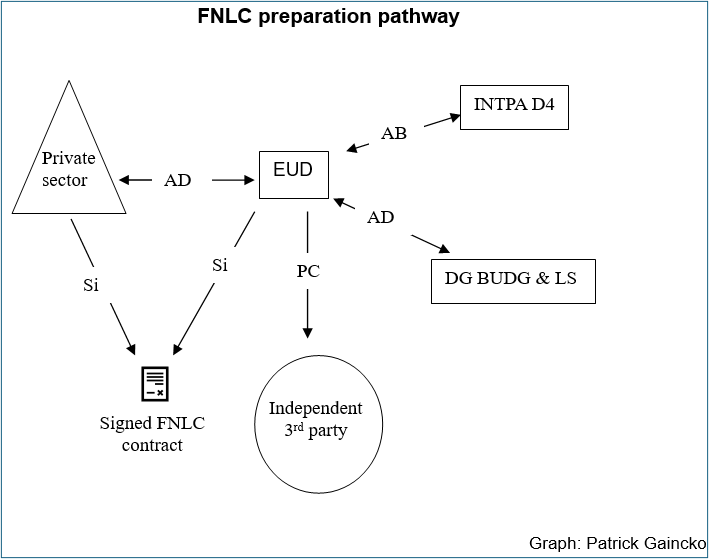
EUD: European Union Delegation
DG BUDGET: European Commission's Directorate-General for Budget
LS: Legal Service
INTPA: Directorate-General for International Partnerships
AD = Action design, PC = Ground price check, AB = Adaptation on logical framework and budget, AD = Authorization decision preparation, Si = Signature, Si = Signature
Note: This diagram is Patrick Gaincko’s interpretation of the FNLC process. It is intended for illustration and should not be considered as official EU procedural guidance.
This is an overview of the expected impact of FNLC:
Reduced cost-reporting burden, because payments are validated upon agreed results
Potentially fewer disputes, because payments are based on quantifiable milestones
Stronger focus on delivering results vs justifying expenditures
One question naturally follows:
Before FNLC, the question asked during the project design phase was: What expense will be eligible?
Today, the question is: Which result will be achieved and how will it be measured?
The model therefore increases the strategic importance of project design, monitoring, evaluation and implementation capacity.
Its success, however, depends on whether the funder and the beneficiary can define measurable results and agree on credible performance indicators.
Strategic Updates: The Université Senghor-Olive People partnership supporting a new chapter of industry-education connection
In May 2026, the new campus of Université Senghor in Alexandria Egypt was inaugurated by the Presidents of Egypt and France, reflecting the strategic importance attached to this pan-African university under the auspices of the Organisation Internationale de la Francophonie (OIF) and its role in preparing the next generation of African leaders.
Building on this momentum, Olive People and Université Senghor have signed a partnership agreement to design and implement a series of initiatives aligning closely with Senghor's 2026–2030 Strategic Plan.
The Plan positions the University for a new phase of growth centred on employability, public-private partnerships, innovation, entrepreneurship, artificial intelligence, international cooperation and sustainable development.
This partnership enables Olive People to help strengthen a university's capacity to connect education with industry needs, foster dialogue between academia leaders and industry leaders, and contribute to an ecosystem that brings talent, employers, investors, and development partners together to accelerate Africa's sustainable development.
Why this matters: As universities rethink their role beyond teaching and research, strategic partnerships that connect education, employers and innovation are becoming a defining lever for the performance of organizations and sustainable growth of economies.
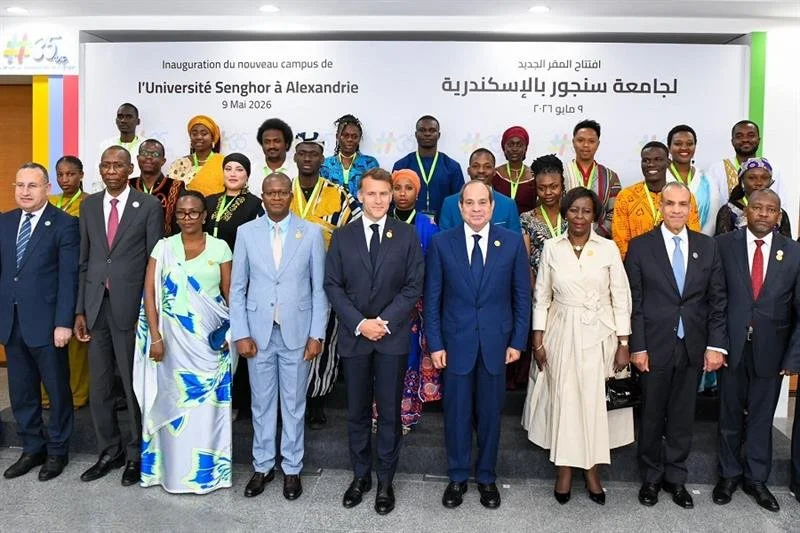
The inauguration of Université Senghor's new campus by Presidents Abdel Fattah El-Sisi and Emmanuel Macron marked the beginning of a new phase of expansion.
Olive People's partnership with the University contributes to this broader institutional ambition of strengthening employability, innovation and public-private collaboration across Africa.
About the Olive People Briefing
The OP Briefing is written by Patrick Gaincko, PMP®, PHRi™, Founder at Olive People. Distribution by Carole Kroonen, Project Officer at Olive People, and research by Lamia Boujjat, Communications Specialist at Olive People.
The OP Briefing aims to inform leaders’ decisions playing a greater role in shaping, building, and mobilizing competencies and capacities. It leverages Olive People’s insights, analyses, and work in workforce development, private sector engagement, and skills ecosystem design.
What they say about the Olive People Briefing
Je vous remercie pour cette information, dont nous allons tirer parti.
Pouvons-nous relayer ce numéro dans notre newsletter ?
Benoit Jobbé-Duval, Directeur Général, Association Technique Internationale des Bois Tropicaux (ATIBT)
Très intéressant, merci pour le partage!
J'ai partagé dans mon réseau.
Marie Hélène Pingoud, General Manager, Jaune Congo
Do you have a comment? Or the Briefing is not something for you? Or you want to share a suggestion?
Please contact us via the form below. Thank you.